
September 19, 2025
AAP June 2025 StatShot Report: Overall Publishing Industry Down 1.3% for Month of June, and Down 1.7% Year-To-Date

Trade (Consumer Book) Revenues Down 2.8% for Month of June, and Down 2.8% Year-to-Date
The Association of American Publishers (AAP) today released its StatShot report for June 2025 reflecting reported revenue for Trade (Consumer Books), Religious Presses, Higher Education Course Materials, and Professional Publishing.
Total revenues across all categories for June 2025 were down 1.3% as compared to June 2024, coming in at $1.1 billion. Year-to-date revenues were down 1.7%, at $6.3 billion for the first six months of the year.
Trade (Consumer Books) Revenues
June
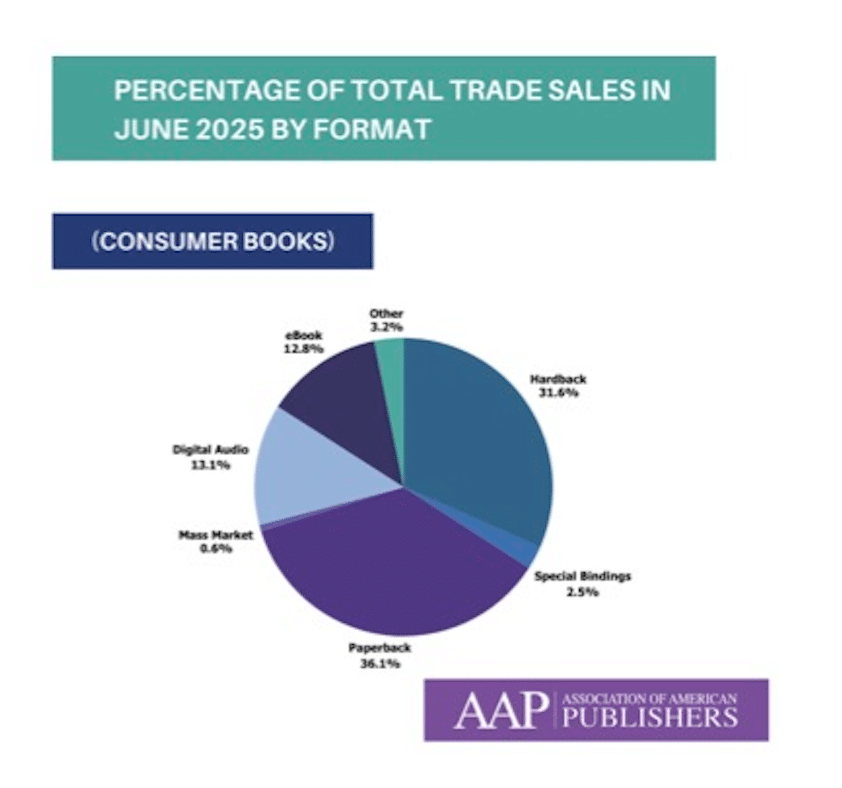
Trade (Consumer Books) revenues were down 2.8% in June at $675.5 million. In terms of physical paper format revenues during the month of June, in the Trade (Consumer Books) category, Hardback revenues were down 1.5%, coming in at $213.5 million; Paperbacks were down 6.8%, with $243.9 million in revenue; Mass Market was down 66.2% to $3.9 million; and Special Bindings were up 8.6%, with $17.0 million in revenue.
eBook revenues were flat at $86.2 million for the month, and revenues from the Digital Audio format were up 16.9% for June, coming in at $88.7 million in revenue. Physical Audio revenues were down 4.3%, coming in at $700 thousand.
Year-to-date
Year-to-date Trade revenues were down 2.8% at $4.3 billion for the first six months of the year. Hardback revenues were up 0.7%, coming in at $1.5 billion; Paperbacks were down 8.1%, with $1.5 billion in revenue; Mass Market was down 29.8% to $42.0 million; and Special Bindings were down 1.5%, with $89.9 million in revenue.
eBook revenues were up 2.4%, as compared to the first six months of 2024, for a total of $526.7 million. The Digital Audio format was up 5.3%, coming in at $500.8 million in revenue. Physical Audio revenues were down 35.5%, coming in at $2.7 million.
Religious Presses
June
Religious press revenues were up 2.2% in June, coming in at $59.6 million. Hardback revenues were up 10.3% to $37.3 million in revenue, while Paperback revenues were down 23.3% to $9.5 million. eBook revenues were up 6.5%, coming in at $4.3 million.
Year-to-date
On a year-to-date basis, religious press revenues were up 0.1%, at $408.9 million. Hardback revenues were up 1.1% at $249.1 million in revenue, Paperback revenues were down 7.7% to $72.5 million, and eBook revenues were down 6.0 at $25.1 million.
Higher Education
During June 2025, revenues from Higher Education Course Materials were $153.0 million, down 2.2% compared with June 2024. Year-to-date Higher Education Course Materials revenues were $1.09 billion, up 5.2% compared to the first six months of 2024.
Professional Books
Professional Books, including business, medical, law, technical and scientific, were down 14.8% during the month, coming in at $37.4 million. Year-to-date Professional Books revenues were $212.6 million, down 7.7% as compared to the first six months of 2024.
AAP’s StatShot
AAP StatShot reports the monthly and yearly net revenue of publishing houses from U.S. sales to bookstores, wholesalers, direct to consumer, online retailers, and other channels. StatShot draws revenue data from approximately 1,300 publishers, although participation may fluctuate slightly from report to report.
StatShot reports are designed to give ongoing revenue snapshots across publishing sectors using the best data currently available. The reports reflect participants’ most recent reported revenue for current and previous periods, enabling readers to compare revenue on both a month-to-month and year-to-year basis within a given StatShot report.
Monthly and yearly StatShot reports may not align completely across reporting periods, because: a) The pool of StatShot participants may fluctuate from report to report; and b) Like any business, it is common accounting practice for publishing houses to update and restate their previously reported revenue data. If, for example, a business learns that its revenues were greater in a given year than its reports first indicated, it will restate the revenues in subsequent reports to AAP, permitting AAP in turn to report information that is more accurate than previously reported.