Press Release

AAP StatShot Report Covering the First Quarter of 2026: Overall Industry Was Up 0.9%

AAP StatShot Report Covering the First Quarter of 2026: Overall Industry Was Up 0.9%

Today, the Association of American Publishers (AAP) released its StatShot report covering the first three months of 2026 reflecting reported revenue for Trade (Consumer Books), Education (combines PreK-12 Instructional Materials and Higher Education Course Materials), and Professional & Scholarly Publishing.

Total revenues across all categories for the first quarter of the year were up 0.9% as compared to the first three months of 2025, coming in at $2.9 billion.

Trade (Consumer Books) Revenues for First Quarter of 2026

Trade (Consumer Books) sales were up 0.2% during the first three months of the year, coming in at $2.2 billion. Within the Trade category, books for adults decreased 0.5% to $1.5 billion compared to the first three months of 2025 while books for children and young adults increased 2.6% to $560.7 million.

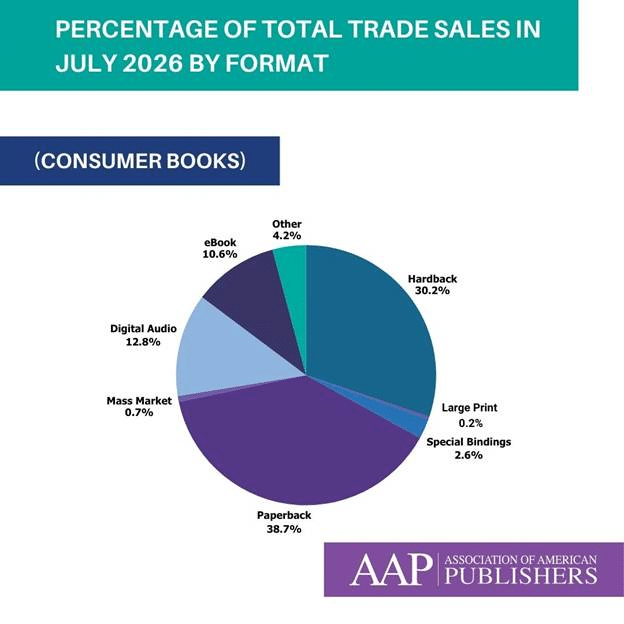
In terms of physical paper format revenues during the first quarter, in the Trade (Consumer Books) category, Hardback revenues were down 6.5%, coming in at $760 million; Paperbacks were up 4.2%, with $796.2 million in revenue; Mass Market was down 75.6% to $5.2 million; and Special Bindings were up 21.6%, with $57.4 million in revenue.

eBook revenues were down 5% as compared to the first three months of 2025, for a total of $261 million. Digital Audio was up 15.9% for the first three months, coming in at $302.3 million in revenue. Physical Audio was down 11.4%, coming in at $1.3 million.

Trade (Consumer Books) Revenues by Month

January

Trade (Consumer Books) sales were down 4.5% in January, coming in at $754.8 million. In terms of physical paper format revenues during the month of January, in the Trade (Consumer Books) category, Hardback revenues were down 11.3%, coming in at $263.1 million; Paperbacks were up 0.3%, with $272.3 million in revenue; Mass Market was down 68.5% to $3.6 million; and Special Bindings were down 3.4%, with $19.6 million in revenue.

eBook revenues were up 3.6% at $85.2 million for the month, and revenues from the Digital Audio format were up 5.9% for January, coming in at $94.1 million in revenue. Physical Audio revenues were down 32.1%, coming in at $500 thousand.

February

Trade (Consumer Books) sales were up 5.9% in February, coming in at $758.9 million. In terms of physical paper format revenues during the month of February, in the Trade (Consumer Books) category, Hardback revenues were up 5%, coming in at $256.1 million; Paperbacks were up 7%, with $254.6 million in revenue; Mass Market was down 85.3% to $900 thousand; and Special Bindings were up 18%, with $18.2 million in revenue.

eBook revenues were down 13.1% at $90.9 million for the month, and revenues from the Digital Audio format were up 27.9% for February, coming in at $117.2 million in revenue. Physical Audio revenues were up 16.8%, coming in at $400 thousand.

March

Trade (Consumer Books) sales were down 0.4% in March, coming in at $722.4 million. In terms of physical paper format revenues during the month of March, in the Trade (Consumer Books) category, Hardback revenues were down 11.5%, coming in at $240.9 million; Paperbacks were up 5.7%, with $269.3 million in revenue; Mass Market was down 80.5% to $700 thousand; and Special Bindings were up 70.2%, with $19.6 million in revenue.

eBook revenues were down 5.9% at $82.8 million for the month, and revenues from the Digital Audio format were up 13.4% for March, coming in at $91 million in revenue. Physical Audio revenues were up 1.4%, coming in at $400 thousand.

Religious Presses Down 1.4% First Quarter of 2026

Religious press revenues were down 1.4% during the first three months of 2026, coming in at $219.6 million. Hardback revenues were down 4.3% to $130.2 million in revenue, Paperback revenues were up 1.3% to $42.4 million, eBook revenues were up 0.5% coming in at $13.3 million, and Digital Audio revenues were up 2% at $12.5 million.

Professional & Scholarly Publishing Up 5.7% for First Quarter of 2026

Professional & Scholarly Publishing, including business, medical, law, technical, scientific, and other books were up 5.7% during the first three months of the year, coming in at $104.1 million.

Education Materials (combines PreK-12 Instructional Materials and Higher Education Course Materials) Up 3.2% for First Quarter of 2026

During January 2026, revenues from Education Materials were $211.1 million, down 4.8% compared with January 2025. In February, Education Materials revenues were $185 million, up 13.9% from February 2025. For March, Education Materials revenues were $113.7 million, up 3.4% compared with March 2025. Year-to-date Education Materials revenues were $509.7 million, up 3.2% compared to the first three months of 2025.

AAP’s StatShot

AAP StatShot reports the monthly and yearly net revenue of publishing houses from U.S. sales to bookstores, wholesalers, direct to consumer, online retailers, and other channels. StatShot draws revenue data from approximately 1,416+ publishers, although participation may fluctuate slightly from report to report.

StatShot reports are designed to give ongoing revenue snapshots across publishing sectors using the best data currently available. The reports reflect participants’ most recent reported revenue for current and previous periods, enabling readers to compare revenue on both a month-to-month and year-to-year basis within a given StatShot report.

Monthly and yearly StatShot reports may not align completely across reporting periods, because: a) The pool of StatShot participants may fluctuate from report to report; and b) Like any business, it is common accounting practice for publishing houses to update and restate their previously reported revenue data. If, for example, a business learns that its revenues were greater in a given year than its reports first indicated, it will restate the revenues in subsequent reports to AAP, permitting AAP in turn to report information that is more accurate than previously reported.

Press Release

Pulitzer Prize Winning Biographer Jon Meacham and Copyright Scholar Paul Goldstein Headline AAP’s Annual Meeting

Pulitzer Prize Winning Biographer Jon Meacham and Copyright Scholar Paul Goldstein Headline AAP’s Annual Meeting

Distinguished Authors Speak to America’s 250th Birthday and the 50th Anniversary of the 1976 Copyright Act

On May 7th, the Association of American Publishers hosted its 2026 annual meeting celebrating the 250th birthday of the United States and the rich publishing tradition that has been central to the nation since its earliest days. Also front and center were the copyright principles that remain integral to incentivizing and protecting works of authorship and a vibrant modern industry today.

Leadership Remarks

In welcoming members and guests, President and CEO Maria A. Pallante said: “It is my pleasure to open this meeting, which we convene in the 250th year of the United States, on Zoom, which they most definitely did not have in 1776, although they did have —and deeply valued— authors, publishers, and innovators.” Ms. Pallante highlighted major inflection points of the past year, including a historic $1.5 billion dollar settlement pending against Anthropic; a suit by 13 AAP member companies in March against the notorious pirate site Anna’s Archive; and the class action suit filed earlier in the week by Elsevier, Cengage, Hachette, Macmillan, McGraw Hill, and author Scott Turow, against Meta and Mark Zuckerberg for industrial scale infringement and a trail of market harm from its Llama AI models. Observing that fair use is an equitable doctrine, Ms. Pallante said there is nothing equitable about what Meta has done. Additionally, she said it was time to revisit legislation that would block pirate sites from doing business in the United States, consistent with the laws of more than 50 countries.

Board Chair Tyrrell Mahoney, President of Chronicle Books, called it an honor to serve during such a momentous year. “I have experienced first-hand that this industry is strongest when working together to foster an enduring love of books,” she said. “Publishers were central to the founding of the country and are critical to its future; and we continue to honor and sustain that tradition because we believe in every generation of author, educator, and reader. Few enterprises have achieved such longevity and collective inventiveness.” She spoke eloquently about how “publishers helped build this country” by to the present day, “developing books for all ages and interests, alongside educational and scholarly works that span the limitless areas of human discovery and imagination.” In recognizing AAP’s Board and members, Chair Mahoney noted, “If the last 250 years show us anything, it is that publishing endures because it adapts…that is the work we celebrate today, and the commitment we carry forward together.”

Keynote Addresses

Pulitzer Prize-winning biographer and historian Jon Meacham, who is also a scholar at Vanderbilt University, and distinguished copyright expert Paul Goldstein, a longtime professor at Stanford Law School, shared the keynoting honors before a virtual audience of nearly five hundred  publishing professionals of all levels who tuned in to watch, with the numbers even higher given that many houses organized group watch events for the historic meeting.

Mr. Meacham is the prolific, award-winning author of numerous New York Times bestselling books, including American Lion: Andrew Jackson in the White House, which won the Pulitzer Prize for Biography; And There Was Light: Abraham Lincoln and the American Struggle; and His Truth is Marching On: John Lewis and the Power of Hope. Speaking with his longtime editor Andy Ward, who is Executive Vice President and Publisher at Random House, Mr. Meacham drew on his latest book, American Struggle: Democracy, Dissent, and the Pursuit of a More Perfect Union (Random House). In reflecting on the invaluable role of publishers in our nation’s founding, Mr. Meacham commented that “there would be no constitutional republic without the published written word.” He noted that publishers made available the arguments of revolutionaries for “eyes and ears” so they could reach “minds and hearts and lead to action.” He also spoke to the fact that there was no mythical prior moment in history where everything was great, and the publishing community is especially well positioned to craft a better future through the power of speech.

Mr. Goldstein, one of the nation’s foremost authorities on both domestic and international intellectual property law, spoke in conversation with Maria Pallante about the legacy of the 1976 Copyright Act on its 50th anniversary, including the people who drafted it, the courts that interpreted it, and the future legal landscape for copyright and AI. Mr. Goldstein is the author of twelve books including the influential five-volume legal treatise Goldstein on Copyright (Wolters Kluwer), and the acclaimed, general audience book Copyright’s Highway: From the Printing Press to the Cloud (Second Edition, Stanford University Press). His novel Havana Requiem: A Legal Thriller won the Harper Lee Prize for Legal Fiction. He reminded attendees that “we had copyright in this country before we had a constitution” and that publishing was at its center. He predicted that in the battle over copyright and AI, the future would feature licensing, and that markets flooded by generative AI material are a growing, serious problem. In closing, Mr. Goldstein poignantly noted that “people want authenticity…and only a publisher can guarantee authenticity.”

Distinguished Public Service Award

Senator Josh Hawley of Missouri received AAP’s Distinguished Public Service Award for his leadership on copyright policy and advocacy for authors and publishers against industrial scale copyright infringement by AI companies, which he has called “the largest intellectual property theft in American history.” The Award honors individuals who have made “outstanding contributions to the public good by advancing laws or policies that respect the value, creation, and publication of original works of authorship.”

A senior member of the Senate Judiciary Committee, Senator Hawley convened a watershed hearing in 2025 as Chair of the Crime and Counterterrorism Subcommittee, titled Too Big to Prosecute?: Examining the AI Industry’s Mass Ingestion of Copyrighted Works for AI Training. Brief video clips of the hearing, played during the annual meeting, are available here.

Sponsorships

AAP wishes to thank this year’s event sponsors Davis Wright Tremaine LLP; Industry Insights; and Total Compensation Solutions.

AAP | The Association of American Publishers represents the leading book, journal, and education publishers in the United States on matters of law and policy, advocating for outcomes that incentivize and protect works of authorship and the creative, intellectual, and financial investments that make them possible. As essential participants in local markets and the global economy, our members invest in and inspire the exchange of ideas, transforming the world we live in one word at a time. Find us online at www.publishers.org or on Twitter and Instagram at @AmericanPublish.

Press Release

Publishers and Authors File Class Action Lawsuit Against Meta and Zuckerberg for Willful Copyright Infringement to Develop Llama AI Models

Publishers and Authors File Class Action Lawsuit Against Meta and Zuckerberg for Willful Copyright Infringement to Develop Llama AI Models

Today, five major publishing houses, Elsevier Inc.; Cengage Learning, Inc.; Hachette Book Group, Inc.; Macmillan Publishing Group, LLC d/b/a Macmillan Publishers; and McGraw Hill LLC; and the best-selling author Scott Turow (the “Plaintiffs”); filed a putative class action lawsuit against Meta and its founder and CEO, Mark Zuckerberg (the “Defendants”), for willful infringement of millions of textual works, including literature, educational works, and scholarly articles, to develop Meta’s Llama large language models. The Plaintiffs bring claims on behalf of themselves and a proposed class of similarly situated copyright owners with similar claims against Meta and Zuckerberg.

This suit is a unified effort by companies across the academic, education, and trade publishing sectors seeking to hold Meta and Zuckerberg responsible for their broadly damaging, self-interested misconduct. As the complaint details, the Defendants willfully defied the constitutional principles and well-established contours of the Copyright Act, which serves the public by incentivizing, rewarding, and protecting creative and intellectual authorship.

At issue in this case is the protection of invaluable intellectual property that belongs to authors and publishers, including tremendous works of fiction, nonfiction, children’s books, memoirs, and poetry, as well as educational works and scholarly articles that span thousands of subject areas and research developments. This case is the first AI action brought by major publishing houses, who have their own story to tell about Meta’s flagrant violation of their rights. The Plaintiffs seek to protect the integrity and enforceability of the copyright laws on which publishing and the public depend.

The complaint describes how Defendants stole millions of copyrighted works, at Zuckerberg’s direction, and then built a multibillion-dollar empire on the backs of publishers and authors. It describes how Meta, at Zuckerberg’s behest, downloaded unauthorized web scrapes of virtually the entire internet, including content that is available only by subscription, and torrented countless protected books and journal articles from notorious pirate sites, such as LibGen and Anna’s Archive. The Plaintiffs explain that Meta’s decisions to infringe were deliberate and expedient. Meta chose to live by its motto of “move fast, and break things,” and now must be held accountable for what it broke, including the copyright laws.

As detailed in the complaint, Meta’s infringement harms the Plaintiffs and their markets for books and journal articles in multiple ways, including by undermining licensing markets and creating, in effect, “an infinite substitution machine.” It also alleges that Mark Zuckerberg, as Meta’s founder, chairman, CEO, and controlling shareholder, “is the guiding force behind Meta AI” and personally authorized and explicitly directed the infringement.

The case, captioned as Elsevier Inc. et al. v. Meta Platforms, Inc. and Mark Zuckerberg, was filed in the U.S. District Court for the Southern District of New York. The Plaintiffs seek monetary and injunctive relief against Defendants, including an order to destroy all infringing copies in defendants’ possession or control.

Key excerpts from the Complaint:

• In their effort to win the AI “arms race” and build a functional generative AI model, Defendants Meta and Mark Zuckerberg followed their well-known motto: “move fast and break things.” They first illegally torrented millions of copyrighted books and journal articles from notorious pirate sites and downloaded unauthorized web scrapes of virtually the entire internet. They then copied those stolen fruits many times over to train Meta’s multi-billion-dollar generative AI system called Llama. In doing so, Defendants engaged in one of the most massive infringements of copyrighted materials in history.
• While AI technology may be new, the legal principles at the center of this case are not. Copyright law applies to AI companies and their leaders, including Defendants, with the same force as every other company that has complied with these laws for decades. If left unaddressed, Defendants will continue to infringe Plaintiffs’ and the Class’s rights, cause broad and lasting damage to the publishing industry and authors, and weaken the incentive to create that is at the core of the Copyright Act. These facts are not a referendum on AI technologies, but rather their greedy and irresponsible deployment.
• Meta deliberately targeted books and journal articles because they possess characteristics uniquely useful to large language model (“LLM”) development, including length, narrative coherence, structural consistency, and professionally edited expression. Unlike fragmented and low-quality internet text, books train models on how to generate outputs that sustain complex arguments, develop characters and themes over time, organize material across chapters, and generate long-form prose that mirrors the quality and cadence of human-authored works. Journal articles are uniquely useful to LLM development for many of the same reasons: they form a highly curated, professional, trusted, and authoritative system of the expression of scientific research, built by the collaboration of leading scholars and publishers over centuries.
• The risk of Llama competing with texts written by human authors for sales and attention is not theoretical—it’s happening. One user describes prompting a “100-chapter fictional book” from “a single prompt using Llama 3.1 70B!” and celebrates that Llama can “Write entire scientific papers” and “Write entire educational textbooks (will those still be needed?).” Another writer released three books in three months and accidentally left in the published text an AI prompt asking it to “rewrite” passages “to align more with” the work of a specific, published author identified by name. Yet another prolific writer, who markets herself as an international bestseller and Amazon Top 10 seller, published 171 books in the last seven years and left a similar AI-prompted snafu in a published book.
• The harm from Defendant’s infringement is not limited to competing outputs. It also occurs at the point of ingestion, where Defendants copied copyrighted works as inputs to build a valuable commercial system without consent or compensation. That conduct appropriates the economic value of the works, eliminates a legitimate licensing market, and allows Defendants to free-ride on investments they did not make. This is precisely the type of harm that copyright is designed to prevent.

The Plaintiffs are represented by Oppenheim + Zebrak, LLP; Debevoise & Plimpton LLP; and Keller Rohrback L.L.P. These firms will work on the case on behalf of the putative class and plan to seek appointment as class counsel to represent all class members.

Read the full complaint here.

About the Plaintiffs

The named plaintiffs are publishers Cengage Learning, Inc.; Elsevier Inc.; Hachette Book Group, Inc.; Macmillan Publishing Group, LLC d/b/a Macmillan Publishers; McGraw Hill LLC; and author Scott Turow.

The publisher plaintiffs publish and curate the important, beloved, and award-winning works of many of the world’s most acclaimed authors as well as leading educators and experts in various educational, scholarly, and scientific fields. They are global leaders who partner with brilliant authors to deliver works that educate, inform, and inspire every type of reader.

Author plaintiff Scott Turow is the author of 14 bestselling works of fiction, including Presumed Innocent, Innocent, Identical, Testimony, and The Last Trial. His books have been translated into more than 40 languages, sold more than 40 million copies worldwide, and have been adapted into movies and television projects.

About the AAP

The Association of American Publishers is the publishing industry’s law and policy advocate, with a particular focus on copyright and freedom of expression issues. In keeping with its nonprofit mission, AAP provides legal expertise and information to its members and serves as a trusted resource on important industry developments that affect publishers and authors. As this class action moves forward, AAP will help share legal and procedural information. The five publishing plaintiffs in this case are all members of the organization and if successful would represent a class that includes many if not all AAP members as well as other copyright owners.

Statements

Maria A. Pallante, President and CEO, AAP:

“The Association of American Publishers enthusiastically supports this important class action which abundantly illustrates that Meta made calculated decisions to enrich itself with literary properties that it did not create and does not own, when instead it could have partnered with publishers and authors. In this 250th year of the United States, let’s remember that creators and innovators have always worked together to achieve public progress, by inspiring, educating, informing, and empowering human beings. Meta’s mass-scale infringement isn’t public progress, and AI will never be properly realized if tech companies prioritize pirate sites over scholarship and imagination.”

Scott Turow, Author:
“All Americans should understand that the bold future promised by A.I., has been, to paraphrase the investigative writer Alex Reisner, created with stolen words. It is all the more shameful that these violations of the law were undertaken by one of the richest corporations in the world.”

Philip Moyer, President and CEO, McGraw Hill:
“We believe artificial intelligence has had and will increasingly have an important role in education and learning. But we also believe in protecting the foundational intellectual property rights of human authors around the globe who create original content. There is a vibrant market for AI companies to license intellectual property, and it is well established that AI models can be built and innovation can flourish without violating these rights.”

Jon Yaged, CEO, Macmillan Publishers:
“The Copyright Act has long been the foundation for safeguarding intellectual property. That protection is needed now more than ever. It is unconscionable that one of the world’s most valuable companies chose to steal millions of works from creators for its own self-enrichment. By joining this suit alongside industry peers and authors, Macmillan Publishers is sending a clear signal that we will fight to protect our authors’ works and the established trust we have with our readers.”

David Shelley, CEO, Hachette Book Group:
“Copyright is the bedrock of all creative industries. Meta, and Mark Zuckerberg, chose not to compensate rights holders for the use of their works and, instead, downloaded pirated works to train their models in contravention of the long-standing copyright principle that creators must be compensated for their works. Sanctioning such a wholesale theft would be devastating to all authors and to the entire publishing industry. So I’m proud that we’ll be standing up in this fight next to our long-time author Scott Turow, who has been not only an enduring talent in our industry, but also a strong advocate for authors throughout his career.”

Youngsuk Chi, Chairman, Elsevier:

“We believe deeply in the promise of AI, and in the importance of building it on a foundation that respects authors, upholds trust, and sustains the global research and healthcare ecosystem. This action reflects a simple principle: that those who create and invest in the expression of knowledge should be supported by clear and consistent protections.”

Michael Hansen, CEO Cengage:

“Artificial intelligence presents an immense opportunity. We see its impact in education today, expanding access, improving outcomes and better connecting learning to work. We fully embrace the potential of AI to deliver on the long-awaited promise of personalized learning. Strong intellectual property protections are fundamental to the innovation that makes this progress possible. As AI evolves, it must be developed and deployed in ways that respect and uphold these protections. The path forward is about building and scaling AI technologies responsibly, ensuring that the value created is shared fairly and that the integrity of published content remains strong for audiences everywhere.”

Press Release

Publishers Celebrate World IP Day 2026 – IP and Sports: Ready, Set Innovate

Publishers Celebrate World IP Day 2026 – IP and Sports: Ready, Set Innovate

As announced by the World Intellectual Property Organization in Geneva, this year’s World Intellectual Property Day highlights the essential and ubiquitous role of IP in nearly every aspect of sports. We are pleased to celebrate this theme with our colleagues around the globe.

“The only thing better than watching athletes is reading about their stories!,” commented Maria A. Pallante, AAP President and CEO. “From Olympians to professional icons to college superstars, the accomplishments and defeats of our sports heroes are deeply felt by all of us and available in books across every genre and format for readers of every level. We commend the publishers who bring these stories to light and thank WIPO for celebrating the far-reaching benefits of intellectual property protections.”

Press Release

Book, News, and Journal Publishers Join with Authors in Amicus Brief in Support of Music Publishers in Concord v. Anthropic

Book, News, and Journal Publishers Join with Authors in Amicus Brief in Support of Music Publishers in Concord v. Anthropic

On March 30, 2026, the Association of American Publishers (AAP), News/Media Alliance (N/MA), International Association of Scientific, Technical & Medical Publishers (STM), and Authors Guild (AG) filed an amicus brief supporting the plaintiffs in Concord Music Group v. Anthropic. This case was brought in October 2023 by several music publishers alleging that Anthropic unlawfully used copyrighted musical works, particularly a large corpus of song lyrics, for training the AI product Claude. The case is before the United States District Court for the Northern District of California.

The joint amicus brief explains that copyright law does not permit Anthropic, a multibillion-dollar company, to systematically copy human-authored works without permission, let alone to enrich itself by generating content that displaces the works it has taken. On fair use factor one, the amici highlight the latest academic research showing that large language models like Claude memorize works used in training in a manner that cannot be “transformative.”

Even more importantly, on fair use factor four, the brief explains how unauthorized training hurts multiple markets for publishers’ valuable content—including providing direct substitutes to readers and undercutting the now-established markets for licensing AI data. As the brief explains, transformative use is a misplaced argument under the facts of this case and would not, in any event, overcome the “copyright owners’ right to exploit established, valuable markets for their works, including the AI training and [retrieval-augmented generation] RAG markets.”

The following is a joint statement from Maria A. Pallante, AAP President and CEO; Danielle Coffey, N/MA President and CEO; Caroline Sutton, STM CEO; and Mary Rasenberger, AG CEO:

“This case illuminates the critical, collaborative licensing markets that are developing among copyright owners and technology companies for consumer-facing AI products, driving better, safer, and fairer outcomes for all involved. These partnerships are clearly in the public’s interest, but they will not be fully realized if categorical fair use arguments are permitted to overtake the equities and promise of the Copyright Act.” 

Excerpts from the brief:

  • Given the widespread adoption of AI-related products throughout virtually all aspects of society, it is clear that the training market for AI systems that depend upon copyrighted works for their very existence is one in which copyright owners would naturally participate—and are participating.
  • Anthropic, a company currently valued at 380 billion dollars, asks this Court to excuse as a fair use massive, commercially motivated copying of song lyrics to enable its large language model (“LLM”) Claude to generate substitutional works—including nearly identical lyrics—a ruling that would have disastrous consequences for the music plaintiffs in this action and the songwriters whose works they invest in and publish.
  • Even beyond the confines of this case, such a ruling could also eviscerate a vital market for authors and publishers of books, news and magazines, scholarly articles, and other textual works who license those works to AI companies to train and operate their LLMs.
  • Anthropic’s peers have obtained licenses to use textual works to develop and operate AI systems. Anthropic, however, seems committed to being a holdout by refusing to share with human authors any of the enormous value it reaps from the exploitation of their works.
  • A healthy and incentivized licensing market advances the goals of copyright by permitting AI companies like Anthropic to access and use high-quality materials to train better, more sophisticated AI models while protecting rightsholders from uncompensated exploitation.
  • Amici’s members’ production of reliable, original news content, literature, scholarship, and other textual works is dependent upon their ability to recoup their investment in quality journalism and authorship. Without copyright protection—and the ability to earn revenue—there would be no sustainable business model for the creation and distribution of creative works.
  • Contrary to AI companies’ claims that their copying is transformative because copied works are not retained in their LLMs, a recent study by Stanford and Yale researchers confirms that textual works do not disappear once ingested into the models, but instead are memorized by the system and can be reproduced as output.
  • The findings of this study mirror those of others concluding that AI systems are not simply “learning” statistical information about works, but storing the works themselves. In short, memorization of copyrighted texts by LLMs like Anthropic’s Claude is far more significant “than previously understood.”
  • Healthy licensing markets advance the core objectives of copyright law by encouraging both the creation and dissemination of expressive works while facilitating efficient and sustainable technological innovation.

The full amicus brief can be found here.

Press Release

AAP Statement on Supreme Court Ruling in Cox Communications vs. Sony Music Entertainment

AAP Statement on Supreme Court Ruling in Cox Communications vs. Sony Music Entertainment

The U.S. Supreme Court yesterday issued a ruling in the case of Cox Communications vs. Sony Music Entertainment. The following is a statement from Terrence Hart, General Counsel for the Association of American Publishers.

“We join our colleagues in the copyright community in expressing our disappointment and concern about the U.S. Supreme Court’s decision in Cox Communications v. Sony Music Entertainment. In addition to ignoring its own judgment on secondary liability as the ‘only practical alternative’ to mitigate digital-age copyright infringement, the concurring opinion by Justice Sotomayor correctly states that the majority’s improper narrowing of secondary liability does substantial harm to Congress’s intent with the Digital Millennium Copyright Act of 1998. It is one thing to decide that the facts of a particular case do not meet a liability threshold, but a far more problematic issue when the Court ‘artificially limit[s]’ liability standards that have a long foundation in common law. We also agree with those who have observed that this ruling emphasizes the need for the United States to catch up with most of the democratic nations of the world in implementing legislation to block access to pirate sites hosting and distributing copyrighted material.”   

Press Release

Publishers File Suit Against Notorious Pirate Site Anna’s Archive

Publishers File Suit Against Notorious Pirate Site Anna’s Archive

The Association of American Publishers (AAP) announced a major infringement suit today against the notorious pirate site Anna’s Archive, brought by thirteen publishing companies across the trade, educational, and professional and scientific publishing sectors.

Apress Media, LLC et al. v. Anna’s Archive and Does 1- 10 was filed in the United States District Court for the Southern District of New York seeking permanent injunctive relief for the copying and distribution of millions of infringing files, both books and research journal articles. The works in suit include an extraordinary scope of authorship, including bestselling titles and winners of the Nobel Prize, Man Booker Prize, Pulitzer Prize, National Book Award, Newbery Medal, and Caldecott Medal.

Statement from Maria A. Pallante, AAP President and CEO:

“Anna’s Archive is a brazen pirate operation that steals and distributes millions of literary works while outrageously offering access to AI developers in exchange for crypto payments. To fight back, we must use all available tools and believe this action in U.S. court will make a difference. The unfortunate reality is that creators face a level of digital piracy today that is so staggering it is almost unbelievable—it is an affront to the public interest.”

As detailed in the complaint, the operators of Anna’s Archive explicitly describe themselves as “pirates” who “deliberately violate the copyright law in most countries,” boldly threatening “to take all the books in the world.” Anna’s Archive also mirrors the pirate repositories of Library Genesis and Z-Library, sites that are the subject of court orders in several jurisdictions and included in the U.S. Trade Representative’s “Review of Notorious Markets for Counterfeiting and Piracy.”  The complaint cites evidence, including the defendants’ own outrageous blog posts, indicating that Anna’s Archive has been soliciting substantial cryptocurrency payments from large language model developers and data brokers in exchange for high-speed access to its repository of “data,” comprising stolen works of authorship.

The publishers seek a legal judgment against Anna’s Archive for willful copyright infringement as well as injunctive relief to help stop its ongoing damage. The plaintiffs also ask the court to direct third-party internet registries, domain name registrars, data centers, and hosting and service providers to assist in ceasing hosting services for the various domain names under which the defendants operate.

Key passages from the Complaint:

  • Anna’s Archive publicly claims to have given “high-speed access” to its illegal collection of more than 140 million copyrighted texts to companies in China, Russia, and elsewhere, many of them LLMs. One court in the Northern District of California recently found that Meta Platforms torrented the contents of Anna’s Archive for use in developing its LLM model Llama. Seeking to capitalize on this market, Anna’s Archive now directly solicits the AI industry to purchase high-speed access to its collection.
  • Pursuant to CPLR § 302(a)(3)(i), Defendants regularly do or solicit business in New York State, engage in a persistent course of conduct in New York State, and derive substantial revenue from services rendered in New York State. For example, Anna’s Archive distributes copyrighted content to New York State residents without authorization, and it further accepts payments from New York residents in exchange for faster downloads of infringing content.
  • The scale of Defendants’ infringement is staggering. Anna’s Archive was created with the express goal “to take all the books in the world,” and it continues its illegal conduct in pursuit of this unlawful aim.
  • Anna’s Archive launched in July 2022 as the “Pirate Library Mirror” (or “PiLiMi”). As Anna’s Archive explained at the time, its original name derived from the fact that the operators “deliberately violate the copyright law in most countries” (i.e., are “pirates”), “focus primarily on written materials like books” (and thus claim to be a “library”), and were then “strictly a mirror of existing” Notorious Pirate Sites. As part of its first project in October 2022, Anna’s Archive mirrored the contents of Z-Library, which it described as “a popular (and illegal) library” and Library Genesis or “LibGen”, one of the world’s largest Notorious Pirate Sites. Anna’s Archive copied over 10 million files from Z-Library and LibGen.
  • Defendants directly profit from their mass infringement business. Anna’s Archive seeks donations through its “Donate” page, and it has solicited “other types of support, such as grants, long-term sponsors, high-risk payment providers, perhaps even (tasteful!) ads.”
  • Defendants also solicit “[e]nterprise-level donation[s]” in exchange for “[u]nlimited high-speed access” and other services. In reality, these “donations” are paid memberships, and Anna’s Archive explicitly refers to donations as “memberships” on its FAQ page.
  • The Atlantic complaint alleged that Anna’s Archive purported to host “61,344,044 books” and “95,527,824 papers” as of the date of filing on December 29, 2025. That Anna’s Archive has apparently added over 2,000,000 books and 100,000 papers in the short time since the Atlantic complaint was filed speaks to the egregious scale of Defendants’ infringement.

About the Association of American Publishers

The Association of American Publishers (AAP) represents the U.S. publishing industry on matters of law and policy, with a particular focus on the copyright, technology, and freedom of expression issues that make publishing possible. Founded in 1970, AAP regularly organizes and supports litigation that is of existential importance to the greater creative community. AAP’s members include large, small, and specialized publishing houses serving both local and global markets. Together, they inform and inspire the public, one work of authorship at a time.

About the Plaintiffs

Plaintiffs in Apress Media, LLC et al. v. Anna’s Archive and Does 1-10 include Apress Media LLC; Cengage Group; Elsevier Inc.; Hachette Book Group, Inc.; HarperCollins LLC; John Wiley & Sons, Inc.; Bedford, Freeman, & Worth Publishing Group, LLC d/b/a Macmillan Learning; Macmillan Publishing Group, LLC; McGraw Hill LLC; Pearson Education, Inc.; Penguin Random House LLC; Simon & Schuster, LLC; Taylor & Francis Group, LLC.

The plaintiffs, and other AAP member publishers, publish and curate the important, beloved, and award-winning works of many of the world’s most acclaimed authors as well as leading educators and experts in various educational, scholarly, and scientific fields. They are global leaders who partner with brilliant authors to deliver works that educate, inform, and inspire every type of reader. Moreover, these publishers are investing in artificial intelligence tools to improve business practices and reader experiences while maintaining emphasis on human authorship as the bedrock of creative and scholarly endeavor.

Read complaint here.

Press Release

2025 USTR Notorious Markets List Issued

2025 USTR Notorious Markets List Issued

AAP Applauds the Agency’s Review of Pirate Sites that are Harmful to Publishers and Authors

Washington, DC; March 4, 2026 —The Association of American Publishers today applauded the release of the 2025 Review of Notorious Markets for Counterfeiting and Piracy by the Office of the U.S. Trade Representative (USTR). The Notorious Markets List identifies prominent examples of online and physical markets around the world “in which pirated or counterfeit goods and services reportedly are available or that facilitate, turn a blind eye to, or benefit from substantial piracy and counterfeiting.”

“On behalf of our member publishers we thank the USTR and the interagency team for its continued focus on Intellectual Property rights, and for the critically important work exposing overseas-based online sites and marketplaces that traffic in infringing copies of books and journal articles,” commented Lui Simpson, Executive Vice President for Global Policy at AAP. “This annual report is an indispensable tool in the ongoing battle to protect the rights of publishers and authors.”

The report highlights the necessity of having an effective framework for dealing with enterprise scale piracy and the complex ecosystem—including “domain name registries and registrars, reverse proxy and other anonymization services, hosting providers, caching services, advertisers and advertisement placement networks, payment processors, social media platforms, search engines, and network management infrastructure—which providers of pirated content abuse.”

The report again lists Libgen, Sci-Hub and their related mirror-sites including several of Anna’s Archive’s domains, which host millions of unauthorized copies of books, manuals, journal articles, academic papers, and other works of authorship.  Both the Libgen and Sci-Hub sites are subject to court orders in Belgium, Denmark, France, Germany, Italy, Portugal, Russia, Spain, Sweden, the United Kingdom, and the United States.

The 2025 USTR Notorious Markets report can be found here.

Press Release

The Association of American Publishers Announces 2026 PROSE Award Winners for Excellence and the R.R. Hawkins Award

The Association of American Publishers Announces 2026 PROSE Award Winners for Excellence and the R.R. Hawkins Award

Cambridge University Press, Simon and Schuster, and Stanford University Press honored with PROSE Awards for Excellence

Top PROSE Awards Honor, the R.R. Hawkins Award, goes to Cambridge University Press’ Atlantic Cataclysm: Rethinking the Atlantic Slave Trades by David Eltis

The Association of American Publishers (AAP), which is currently celebrating the 50th Anniversary of the PROSE Awards, has announced its 2026 Area of Excellence winners, recognizing an outstanding scholarly publication in each of the following four categories: Biological & Life Sciences, Humanities, Physical Sciences & Mathematics, and Social Sciences. 

AAP also announced that the program’s top prize, the prestigious R.R. Hawkins Award, has been awarded to Cambridge University Press’ Atlantic Cataclysm: Rethinking the Atlantic Slave Tradesby David Eltis.

“For fifty years, the PROSE Awards have honored the publishers who deliver the very best in professional and scholarly publishing, and I am delighted to say that the houses behind this year’s Excellence Awards winners have continued that tradition, with stellar works representing all four of the PROSE Categories,” Commented Syreeta Swann, Chief Operating Officer, Association of American Publishers. “Even as we congratulate this year’s exceptional group of honorees, we also applaud each and every PROSE award-winning publishing house that has delivered ground-breaking works over the past half-century. Bravo to all!”

R.R. Hawkins Awards Winner

“Receiving the prestigious R.R. Hawkins Award at this year’s PROSE Awards is a real honour for Cambridge and an extraordinary achievement for David Eltis, whose book Atlantic Cataclysm: Rethinking the Atlantic Slave Trades is rightly recognised for its outstanding contribution to academic scholarship,” commented Mandy Hill, Managing Director, Cambridge University Press. “This award also reflects the shared commitment and close partnership that underpin exceptional publishing. David’s extraordinary scholarship, supported by the dedication and expertise of our publishing team, have enabled us to bring this important piece of work to readers around the world. I’m delighted that the judges have recognised the impact and quality of this work, and I would like to extend my congratulations to all of the winners and finalists.”

“This year’s top honoree, Atlantic Cataclysm: Rethinking the Atlantic Slave Trades, offers a carefully researched, data-driven analysis that dramatically challenges long-held assumptions of the Atlantic slave trade and its aftermath, in the process creating a new understanding of this pivotal period in world history,” commented PROSE Chief Judge Nigel Fletcher-Jones, PhD. “The scholarship and analysis in this work stand out in an already impressive crowd of competitors, and we congratulate Cambridge University Press for producing a work that we believe will swiftly take its place as a touchstone in its field.”

2026 PROSE Excellence Winners are as follows:

R.R Hawkins Award Winner & PROSE Award for Excellence in The Humanities

  • Atlantic Cataclysm: Rethinking the Atlantic Slave Trades by David Eltis, Cambridge University Press

PROSE Award for Excellence in Biological & Life Sciences

  • Slip: Life in the Middle of Eating Disorder Recovery by Mallary Tenore Tarpley, Simon and Schuster

PROSE Award for Excellence in Social Sciences 

  • The Worst Trickster Story Ever Told: Native America, the Supreme Court, and the U.S. Constitution by Keith Richotte, Jr., Stanford University Press

PROSE Award for Excellence in Physical Sciences & Mathematics

  • Decoherence and Quantum Darwinism: From Quantum Foundations to Classical Reality by Wojciech Hubert Zurek, Cambridge University Press

About the PROSE Awards

Since 1976, the AAP’s annual PROSE Awards have recognized publishers who produce books, journals, and digital products of extraordinary merit that make a significant contribution to a field of study. 

During the 2026 PROSE Awards cycle, a prestigious panel of PROSE Awards Judges selected 101 finalists and 37 category winners. Of the 37 exceptional category winners, today’s PROSE Award for Excellence Winners and R.R. Hawkins Award Winner illustrate the highest standards of scholarly publishing, contributing innovative research and impactful scholarship to their respective areas of study.

More information about the 2026 PROSE Awards can be found here.

Press Release

The Association of American Publishers Announces Finalists and Category Winners for 50th Annual PROSE Awards

The Association of American Publishers Announces Finalists and Category Winners for 50th Annual PROSE Awards

The Association of American Publishers (AAP) unveiled the Finalists and Category Winners for the 50th annual PROSE Awards, honoring professional and scholarly works published in 2025. The PROSE Awards, first presented in 1976, recognize professional and scholarly publishers that have made significant advancements in their respective fields of study each year as judged by a multidisciplinary panel of experts.

“This year we are proud to celebrate the 50th anniversary of the PROSE Awards and delighted to announce that the 2026 finalists and category winners include a tremendously impressive selection of scholarly authorship,” commented Syreeta Swann, Chief Operating Officer for the Association of American Publishers. “We send our congratulations to all of this year’s honorees and look forward to the announcement of the 2026 PROSE Awards for 

Excellence winners, as well as the top prize, the R.R. Hawkins Award in the weeks ahead.”

The Category Winners will now be eligible for the next level of PROSE honors – the Awards for Excellence, which will be announced in the coming weeks.

The Awards for Excellence comprise the following:

  • The 2026 PROSE Award for Excellence in Biological and Life Sciences
  • The 2026 PROSE Award for Excellence in Humanities
  • The 2026 PROSE Award for Excellence in Physical Sciences and Mathematics
  • The 2026 PROSE Award for Excellence in Social Sciences

The prestigious R.R. Hawkins Award, the PROSE Award’s highest honor, will be presented to one of the four Excellence winners.

The full list of 2026 Finalists and Category Award winners can be found here.