
November 25, 2025
Association of American Publishers Files Amicus Brief in Support of Plaintiffs in Thomson Reuters v. ROSS, A Key AI Case

On November 25, 2025, the Association of American Publishers (AAP) filed an amicus brief in the important AI case Thomson Reuters v. ROSS, an infringement suit first brought by Thomson Reuters and West Publishing in May 2020 in response to ROSS’s unauthorized use of copyrighted material to train its AI system, including material that copied and incorporated Westlaw headnotes. The case is now before the United States Court of Appeals for the Third Circuit following the February 2025 opinion of the U.S. District Court for Delaware finding ROSS squarely liable for infringement.
AAP’s brief urges the appeals court to affirm the district court’s decision by similarly rejecting ROSS’s fair use arguments as fundamentally inconsistent with copyright precedent, including by rejecting the premise that ROSS’s unabashed copying for AI training was a transformative use under the first factor of fair use. Moreover, the brief emphasizes, the district court properly concluded that ROSS’s AI product directly competed with the Westlaw legal research database and would harm the AI training market.
“Delaware was the first in the nation to recognize that usurping copyrighted materials for AI training is infringement not innovation, and that such actions harm the ongoing development and long-term potential of licensing markets,” commented Maria A. Pallante, President and CEO of the Association of American Publishers. “There is no sweeping exception to copyright law that gives AI companies a free pass to usurp the expression of authors and publishers for commercial gain. We hope the Third Circuit will reinforce the rights of copyright owners to authorize, not suffer, the use of their intellectual property in AI products and tools, and to participate financially in the derivative exploitation of their works. Like the many technologies before AI that have leveraged and depended upon valuable works of authorship for profit and success, AI is a market to which copyright owners are fundamentally entitled.”
Excerpts from the amicus brief include:
- Copyright is a “powerful engine of creativity”—a key driver for the vast catalogs of American literature and other creative works that are treasured around the world. Andy Warhol Found. for the Visual Arts, Inc. v. Goldsmith, 598 U.S. 508, 550 (2023). Marketable exclusive rights have enabled authors and publishers to inform and inspire for generations, and our future society depends on their talents and continued creative contributions.
- AI developers such as ROSS seek a sweeping expansion of fair use for AI training. Their fair use arguments ignore markets to which rightsholders are fundamentally entitled and are both exploiting and preparing to exploit, and press for a theory of transformativeness premised on technological innovation instead of a use tied to the protected works that justifies the copying.
- Fair use does not give a free ride at the copyright owner’s expense where a market exists or is likely to develop for AI training. Recognizing a licensing market for AI training advances the goals of copyright and allows both copyright owners and AI developers to share in the commercial success of AI.
- The technological innovation of AI is no talisman for fair use, or transformativeness for that matter. AI tools, like ROSS’s, exploit creative works for their expressive value and for the same purpose, and do not provide any new information or insights about the works to warrant their taking.
- Moreover, the current state of AI is but one moment in technological development and not a reason to eliminate copyright principles that have served this country since the 18th century.
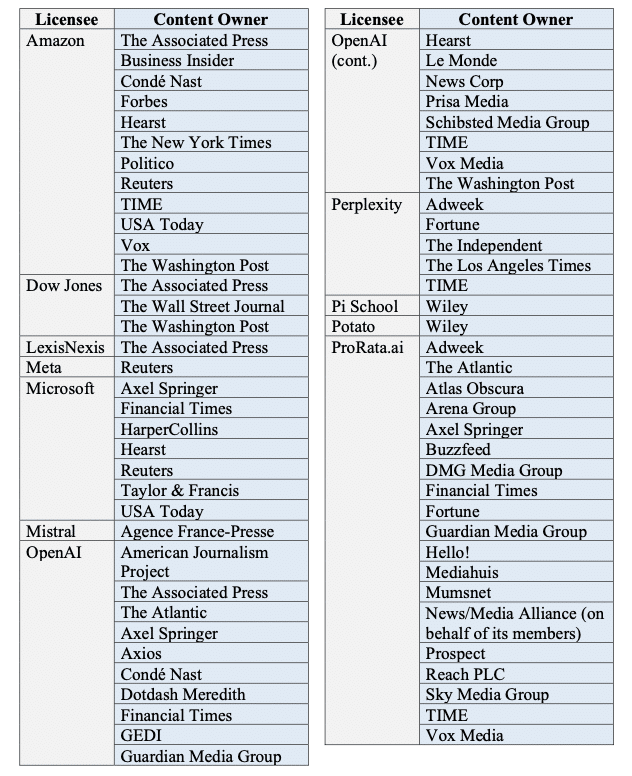
- [R]ightsholders are not only willing but actually are granting licenses to AI developers seeking to use copyrighted textual works to build and operate their AI tools.
- Licensing for AI training is an actual market that is rapidly expanding—to the tune of $6 billion today and $52.4 billion in a decade.
The chart below lists key licensing agreements for textual works that have been publicly reported.
AAP’s full amicus brief can be found here.