Press Release

Publishers Respond to Google’s Opposition in Class Action Infringement Suit

Publishers Respond to Google’s Opposition in Class Action Infringement Suit

The Association of American Publishers (AAP) today announced that Cengage Group and Hachette Book Group have responded in court to Google’s January 29th opposition to their motion to intervene in the case In re In Re Google Generative AI Copyright Litigation.  As articulated in their January 15th motion to the court, Cengage Group and Hachette Book Group would serve as representatives for all publishers whose rights have similarly been infringed by Google.

Today’s reply states that Google’s opposition misrepresents the clear legal interests of publishers in this matter and misstates the law on timeliness of the motion to intervene. As hundreds of publishing houses would become Class members if the Court grants the class certification put forth by the original plaintiffs—which the AAP and its members support—it is important and necessary for publishers to step up to become directly involved and stand shoulder-to-shoulder with authors in the fight to protect two centuries of fundamental copyright law.

“The decisions of some AI developers to trample the rights of authors and publishers while raking in untold profits continues to shock the conscience,” states Maria A. Pallante, AAP President and CEO. “In this infringement lawsuit against one of the largest developers in the world, every creator, current and future, stands to benefit from the expertise and evidence that publishers can provide.”

As stated in today’s response, the authors who initiated this suit welcome the participation of publishers. “Proposed Interventors . . . [would] ensure the publishing industry’s discrete interests are fairly treated in class litigation where both authors and publishers’ rights are at stake,” the response states. “[A] class without publisher representatives risks arguments unmade and necessary evidence missing.” 

The motions and underlying case, which alleges infringement of millions of works to train the AI model “Gemini,” are pending before the United States District Court for the Northern District of California.   

About Cengage Group    

Cengage Group is a global edtech company with over 100 years of experience supporting learners. Their four operating units—Higher Education, School, Work and English Language Learning—serve millions of students from middle school to graduate school and workforce skills training in over 125 countries.  

Cengage empowers student choice through trusted content, AI-driven insights, and scalable digital platforms that connect education to employment, ensuring learners gain career-ready skills and achieve tangible outcomes.

About Hachette Book Group

Hachette Book Group (HBG) is a leading U.S. general interest book publisher made up of dozens of esteemed imprints within the publishing groups Basic Books Group; Grand Central Publishing Group; Hachette Audio; Little, Brown and Company; Little, Brown Books for Young Readers; Orbit; Workman Publishing; and Running Press Group. HBG also provides custom distribution, fulfillment, and sales services to several publishing companies.  

HBG’s books and authors have received the Pulitzer Prize, National Book Award, Caldecott Medal, Newbery Medal, Booker Prize, Nobel Prize, James Beard Award, and other major honors.   

About the Association of American Publishers

The Association of American Publishers (AAP) represents the U.S. publishing industry on matters of law and policy, with a particular focus on the copyright, technology, and freedom of expression issues that make publishing possible. Founded in 1970, AAP regularly organizes and supports litigation that is of existential importance to the greater creative community.  AAP’s members include large, small, and specialized publishing houses serving both local and global markets. Together, they inform and inspire the public, one work of authorship at a time.

Read the reply here.

Press Release

Tyrrell Mahoney, President of Chronicle Books, Elected Chair, AAP Board of Directors

Tyrrell Mahoney, President of Chronicle Books, Elected Chair, AAP Board of Directors

The Association of American Publishers announced today that its Directors have elected Tyrrell Mahoney, President of Chronicle Books, as Chair of the Board for the 2026-2027 term. Ms. Mahoney has served on the AAP Board since 2019, most recently as Vice Chair. Chronicle Books is an independent publishing house headquartered in San Francisco.

The Board also elected Dr. James Milne, President, ACS Publications, to the position of Vice Chair, and Youngsuk ‘YS’ Chi, Chairman of Elsevier and Director of Corporate Affairs for the RELX Group, as Treasurer. Outgoing Board Chair Brian Murray, who is President and CEO of HarperCollins Publishers, will remain an officer in the position of Immediate Past Chair.

“Tyrrell Mahoney has been a knowledgeable and consensus-driven member of the Board for seven years, and an especially important voice for independent houses,” commented Maria A. Pallante, President and CEO, AAP. “There is no question that she assumes the role of Chair at a time of tremendous challenge and change for the industry, and we are thrilled to have her at the helm.”

“We also recognize Brian Murray for his tremendous service to this organization,” added Ms. Pallante. “In completing his second term as Chair since 2008, he has been a leader among leaders for the AAP community.”

“I am honored to step into the role of Chair and work alongside the exceptional AAP team at this pivotal time for our industry,” said Ms. Mahoney. “Maintaining the independence and vitality of publishing in the U.S. has always been at the heart of the AAP’s mission, and this work is now more important than ever. I look forward to collaborating with the entire organization on the AAP’s vital work of preserving copyright protections, safeguarding freedom of expression, addressing the challenges of AI technologies, and upholding publishing’s essential role in our culture.”

About Tyrrell Mahoney

Tyrrell Mahoney has served as President of Chronicle Books since January 2017. She first joined the company in 1996, holding several executive management and sales positions. Tyrrell is a graduate of Boston University with a BA in English. She is a long-time resident of San Francisco.

About AAP

AAP | The Association of American Publishers represents the leading book, journal, and education publishers in the United States on matters of law and policy, advocating for outcomes that incentivize and protect works of authorship and the creative, intellectual, and financial investments that make them possible. As essential participants in local markets and the global economy, our members invest in and inspire the exchange of ideas, transforming the world we live in one word at a time. Find us online at www.publishers.org or on Twitter and Instagram at @AmericanPublish.

Press Release

AAP November 2025 StatShot Report: Overall Publishing Industry Up 1.9% for Month of November, and Up 0.5% Year-To-Date

AAP November 2025 StatShot Report: Overall Publishing Industry Up 1.9% for Month of November, and Up 0.5% Year-To-Date

Trade (Consumer Book) Revenues Up 3.1% for Month of November, and Down 1.7% Year-to-Date

The Association of American Publishers (AAP) today released its StatShot report for November 2025, reflecting reported revenue for Trade (Consumer Books), Religious Presses, and Professional Publishing.

Total revenue across all categories for November 2025 was up 1.9% as compared to November 2024, coming in at $1.2 billion. Year-to-date revenues were up 0.5%, at $13.6 billion for the first eleven months of the year.

Trade (Consumer Books) Revenues

November 

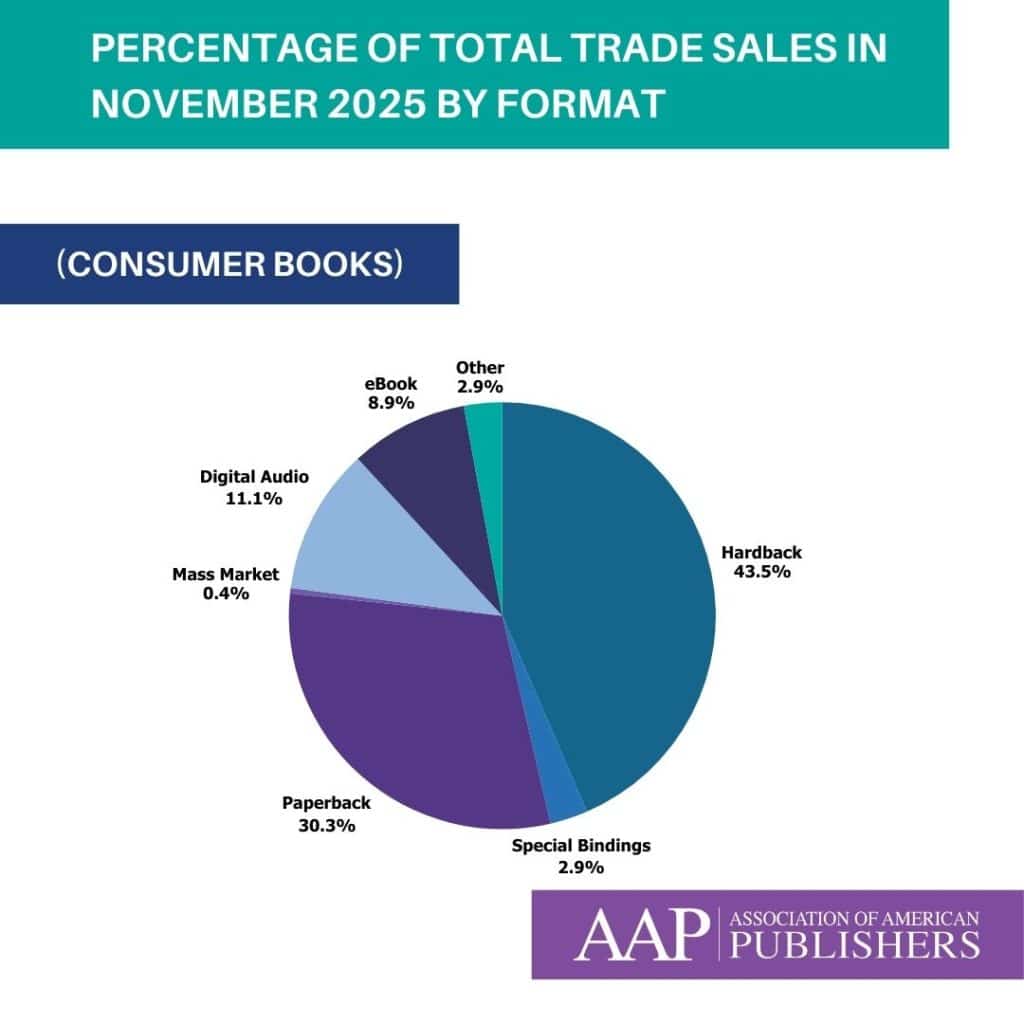
Trade (Consumer Books) revenues were up 3.1% in November at $972 million. In terms of physical paper format revenues during the month of November, in the Trade (Consumer Books) category, Hardback revenues were up 7.3%, coming in at $422.7 million; Paperbacks were down 1.9%, with $294.5 million in revenue; Mass Market was down 66.5% to $3.9 million; and Special Bindings were up 9%, with $27.7 million in revenue. 

eBook revenues were up 2.1% at $86.9 million for the month, and revenues from the Digital Audio format were up 15.8% for November, coming in at $107.6 million in revenue. Physical Audio revenues were down 41.9%, coming in at $500 thousand.

Year-to-date

Year-to-date Trade revenues were down 1.7% at $8.9 billion for the first eleven months of the year. Hardback revenues were up 1.5% on a year-over-year basis, coming in at $3.4 billion; Paperbacks were down 5.6%, with $2.9 billion in revenue; Mass Market was down 26.2% to $81 million; and Special Bindings were down 0.9%, with $210.6 million in revenue.

eBook revenues were flat as compared to the first eleven months of 2024, for a total of $963.7 million. The Digital Audio format was up 2.4%, coming in at $995.3 million in revenue. Physical Audio revenues were down 33.7%, coming in at $5.5 million.

Religious Presses

November  

Religious press revenues were up 7.5% in November, coming in at $106.9 million. Hardback revenues were up 17% to $75.3 million in revenue, while Paperback revenues were down 7.5% to $14.1 million. eBook revenues were up 15.1%, coming in at $4.8 million.

Year-to-date

On a year-to-date basis, religious press revenues were up 1.7%, at $848 million. Hardback revenues were up 1.7% at $530.9 million in revenue, Paperback revenues were down 5.1% to $143.7 million, and eBook revenues were down 0.7% at $46.3 million.

Professional Books

Professional Books, including business, medical, law, technical and scientific, were flat during the month, coming in at $37.5 million. Year-to-date, Professional Books’ revenues were $390.5 million, down 8.3% as compared to the first eleven months of 2024.

AAP’s StatShot

AAP StatShot reports the monthly and yearly net revenue of publishing houses from U.S. sales to bookstores, wholesalers, direct to consumer, online retailers, and other channels. StatShot draws revenue data from approximately 1,300 publishers, although participation may fluctuate slightly from report to report.

StatShot reports are designed to give ongoing revenue snapshots across publishing sectors using the best data currently available. The reports reflect participants’ most recent reported revenue for current and previous periods, enabling readers to compare revenue on both a month-to-month and year-to-year basis within a given StatShot report.

Monthly and yearly StatShot reports may not align completely across reporting periods, because: a) The pool of StatShot participants may fluctuate from report to report; and b) Like any business, it is common accounting practice for publishing houses to update and restate their previously reported revenue data. If, for example, a business learns that its revenues were greater in a given year than its reports first indicated, it will restate the revenues in subsequent reports to AAP, permitting AAP in turn to report information that is more accurate than previously reported.

Press Release

Publishers Move to Intervene in Class Action Suit Against Google for Generative AI Product “Gemini”

Publishers Move to Intervene in Class Action Suit Against Google for Generative AI Product “Gemini”

Direct Participation Would Support Individual Plaintiffs and Bolster Legal Case

The Association of American Publishers (AAP) announced today that two of its member companies, Cengage Group and Hachette Book Group, have moved to intervene as class representatives for publishers in the case In Re Google Generative AI Copyright Litigation, a consolidated class action suit first filed in 2023 by a group of illustrators and writers.

The pending suit, which alleges willful copyright infringement claims against Google for copying millions of books to build and train its commercial, generative AI product “Gemini,” is currently before Judge Eumi K. Lee in the United States District Court, Northern District of California.  

Cengage Group and Hachette Book Group seek to represent all publishers whose rights have similarly been infringed by Google. They would provide a level of expertise and evidence that is of utmost importance in the continuing fight to hold AI companies accountable under the Copyright Act. The publishers’ complaint identifies ten representative works that Google copied to build and train Gemini without permission, including Principles of Economics by M. Gregory Mankiw, Innocent by Scott Turow, and The Fifth Season by N.K. Jemisin.

The publishers have moved to intervene now given recent efforts by the individual plaintiffs to certify a class that includes publishers as copyright owners of many works in suit, and Google’s objection to that effort on various grounds, including purported intra-class complexities. Direct participation by publishers would help address these and other issues so that the case can move forward, further underscoring that publishers are united with authors in this litigation. 

Statement from Maria A. Pallante, AAP President and CEO:

“We thank Cengage Group and Hachette Book Group for their leadership today, as the outcome of this case could have far-reaching consequences for the legal rights, remedies, and livelihoods of authors and publishers. It is no secret that Google and other tech companies have copied books with impunity to fuel their large language AI products. Yet they continue to assert sweeping arguments that would exempt them entirely from the basic rules of permission and accountability that have governed content-intensive technology markets for decades.

“Through today’s action, AAP and its members aim to support the creators suing Google. We believe our participation will bolster the case, especially because publishers are uniquely positioned to address many of the legal, factual, and evidentiary questions before the Court. 

“It is essential to remember that the millions of works at issue in this lawsuit did not spring out of thin air but were conceived, created, developed, perfected, and financed by a creative sector that is dedicated to public progress. From rich works of fiction and nonfiction to high-quality learning materials, we take seriously our mission to inform, inspire, entertain, and educate people of all ages every day, through a variety of formats and delivery models.

“It is understandable that technology companies may want or need creative works to build safe, useful, and compelling AI systems, but this realization should point to a licensing conversation, not a rationalization. Let’s move past these early, free-for-all days of AI development, and get back to the symbiotic partnerships that have always been a hallmark of copyright law.”

About Cengage Group    

Cengage Group is a global edtech company with over 100 years of experience supporting learners. Their four operating units—Higher Education, School, Work and English Language Learning—serve millions of students from middle school to graduate school and workforce skills training in over 125 countries.  

Cengage empowers student choice through trusted content, AI-driven insights, and scalable digital platforms that connect education to employment, ensuring learners gain career-ready skills and achieve tangible outcomes.

About Hachette Book Group

Hachette Book Group (HBG) is a leading U.S. general interest book publisher made up of dozens of esteemed imprints within the publishing groups Basic Books Group; Grand Central Publishing Group; Hachette Audio; Little, Brown and Company; Little, Brown Books for Young Readers; Orbit; Workman Publishing; and Running Press Group. HBG also provides custom distribution, fulfillment, and sales services to several publishing companies.  

HBG’s books and authors have received the Pulitzer Prize, National Book Award, Caldecott Medal, Newbery Medal, Booker Prize, Nobel Prize, James Beard Award, and other major honors.   

About the Association of American Publishers

The Association of American Publishers (AAP) represents the U.S. publishing industry on matters of law and policy, with a particular focus on the copyright, technology, and freedom of expression issues that make publishing possible. Founded in 1970, AAP regularly organizes and supports litigation that is of existential importance to the greater creative community.  AAP’s members include large, small, and specialized publishing houses serving both local and global markets. Together, they inform and inspire the public, one work of authorship at a time.

Read Motion here.

Read Complaint here.

Press Release

AAP October 2025 StatShot Report: Overall Publishing Industry Up 6.7% for Month of October, and Up 0.4% Year-To-Date

AAP October 2025 StatShot Report: Overall Publishing Industry Up 6.7% for Month of October, and Up 0.4% Year-To-Date

Trade (Consumer Book) Revenues Up 3.5% for Month of October, and Down 2.3% Year-to-Date

The Association of American Publishers (AAP) today released its StatShot report for October 2025, reflecting reported revenue for Trade (Consumer Books), Religious Presses, and Professional Publishing.

Total revenue across all categories for October 2025 was up 6.7% as compared to October 2024, coming in at $1.5 billion. Year-to-date revenues were up 0.4%, at $12.4 billion for the first ten months of the year.

Trade (Consumer Books) Revenues

October 

Trade (Consumer Books) revenues were up 3.5% in October at $1.1 billion. In terms of physical paper format revenues during the month of October, in the Trade (Consumer Books) category, Hardback revenues were up 4.5%, coming in at $521.3 million; Paperbacks were up 1.5%, with $350.6 million in revenue; Mass Market was down 22.7% to $7.9 million; and Special Bindings were down 4.9%, with $26.1 million in revenue. 

eBook revenues were up 1.9% at $88.3 million for the month, and revenues from the Digital Audio format were up 7.3% for October, coming in at $92.6 million in revenue. Physical Audio revenues were down 21.1%, coming in at $700 thousand.

Year-to-date

Year-to-date Trade revenues were down 2.3% at $8 billion for the first ten months of the year. Hardback revenues were up 0.7% on a year-over-year basis, coming in at $3 billion; Paperbacks were down 6%, with $2.7 billion in revenue; Mass Market was down 21.4% to $77.1 million; and Special Bindings were down 2.3%, with $182.9 million in revenue.

eBook revenues were down 0.2%, as compared to the first ten months of 2024, for a total of $876.8 million. The Digital Audio format was up 1%, coming in at $887.7 million in revenue. Physical Audio revenues were down 32.7%, coming in at $5 million.

Religious Presses

October 

Religious press revenues were up 10.6% in October, coming in at $102.4 million. Hardback revenues were up 8.6% to $66.8 million in revenue, while Paperback revenues were down 0.1% to $15.6 million. eBook revenues were up 14.3%, coming in at $4.4 million.

Year-to-date

On a year-to-date basis, religious press revenues were up 1.0%, at $741.1 million. Hardback revenues were down 0.4% at $455.7 million in revenue, Paperback revenues were down 4.9% to $129.6 million, and eBook revenues were down 2.2% at $41.5 million.

Professional Books

Professional Books, including business, medical, law, technical and scientific, were flat during the month, coming in at $38.2 million. Year-to-date, Professional Books’ revenues were $352.9 million, down 9.1% as compared to the first ten months of 2024.

AAP’s StatShot

AAP StatShot reports the monthly and yearly net revenue of publishing houses from U.S. sales to bookstores, wholesalers, direct to consumer, online retailers, and other channels. StatShot draws revenue data from approximately 1,300 publishers, although participation may fluctuate slightly from report to report.

StatShot reports are designed to give ongoing revenue snapshots across publishing sectors using the best data currently available. The reports reflect participants’ most recent reported revenue for current and previous periods, enabling readers to compare revenue on both a month-to-month and year-to-year basis within a given StatShot report.

Monthly and yearly StatShot reports may not align completely across reporting periods, because: a) The pool of StatShot participants may fluctuate from report to report; and b) Like any business, it is common accounting practice for publishing houses to update and restate their previously reported revenue data. If, for example, a business learns that its revenues were greater in a given year than its reports first indicated, it will restate the revenues in subsequent reports to AAP, permitting AAP in turn to report information that is more accurate than previously reported.

Press Release

AAP September 2025 StatShot Report: Overall Publishing Industry up 14.4% for Month of September, and Down 0.4% Year-To-Date

AAP September 2025 StatShot Report: Overall Publishing Industry up 14.4% for Month of September, and Down 0.4% Year-To-Date

Trade (Consumer Book) Revenues Up 10.9% for Month of September, and Down 3.2% Year-to-Date

The Association of American Publishers (AAP) today released its StatShot report for September 2025, reflecting reported revenue for Trade (Consumer Books), Religious Presses, and Professional Publishing.

Total revenue across all categories for September 2025 was up 14.4% as compared to September 2024, coming in at $1.7 billion. Year-to-date revenues were down 0.4%, at $10.9 billion for the first nine months of the year.

Trade (Consumer Books) Revenues

September 

Trade (Consumer Books) revenues were up 10.9% in September at $1.0 billion. In terms of physical paper format revenues during the month of September, in the Trade (Consumer Books) category, Hardback revenues were up 14.5%, coming in at $466 million; Paperbacks were up 15.1%, with $321.6 million in revenue; Mass Market was down 6.5% to $8.5 million; and Special Bindings were up 5.4%, with $28.8 million in revenue. 

eBook revenues were down 7.9% at $85.4 million for the month, and revenues from the Digital Audio format were down 0.6% for September, coming in at $89.1 million in revenue. Physical Audio revenues were down 41.3%, coming in at $500 thousand.

Year-to-date

Year-to-date Trade revenues were down 3.2% at $6.8 billion for the first nine months of the year. Hardback revenues were flat on a year-over-year basis, coming in at $2.5 billion; Paperbacks were down 7%, with $2.3 billion in revenue; Mass Market was down 21.2% to $69.2 million; and Special Bindings were down 1.8%, with $156.9 million in revenue.

eBook revenues were down 0.5%, as compared to the first nine months of 2024, for a total of $788.5 million. The Digital Audio format was up 0.3%, coming in at $795.1 million in revenue. Physical Audio revenues were down 34.2%, coming in at $4.4 million.

Religious Presses

September

Religious press revenues were up 21.2% in September, coming in at $92.0 million. Hardback revenues were up 23% to $59.2 million in revenue, while Paperback revenues were up 2.5% to $14.7 million. eBook revenues were up 7.4%, coming in at $4.0 million.

Year-to-date

On a year-to-date basis, religious press revenues were down 0.4%, at $638.6 million. Hardback revenues were down 1.8% at $388.8 million in revenue, Paperback revenues were down 5.5% to $114.1 million, and eBook revenues were down 3.9% at $37.1 million.

Professional Books

Professional Books, including business, medical, law, technical and scientific, were down 12.1% during the month, coming in at $35.2 million. Year-to-date, Professional Books’ revenues were $314.8 million, down 10% as compared to the first nine months of 2024.

AAP’s StatShot

AAP StatShot reports the monthly and yearly net revenue of publishing houses from U.S. sales to bookstores, wholesalers, direct to consumer, online retailers, and other channels. StatShot draws revenue data from approximately 1,300 publishers, although participation may fluctuate slightly from report to report.

StatShot reports are designed to give ongoing revenue snapshots across publishing sectors using the best data currently available. The reports reflect participants’ most recent reported revenue for current and previous periods, enabling readers to compare revenue on both a month-to-month and year-to-year basis within a given StatShot report.

Monthly and yearly StatShot reports may not align completely across reporting periods, because: a) The pool of StatShot participants may fluctuate from report to report; and b) Like any business, it is common accounting practice for publishing houses to update and restate their previously reported revenue data. If, for example, a business learns that its revenues were greater in a given year than its reports first indicated, it will restate the revenues in subsequent reports to AAP, permitting AAP in turn to report information that is more accurate than previously reported.

Press Release

Association of American Publishers Files Amicus Brief in Support of Plaintiffs in Thomson Reuters v. ROSS, A Key AI Case

Association of American Publishers Files Amicus Brief in Support of Plaintiffs in Thomson Reuters v. ROSS, A Key AI Case

On November 25, 2025, the Association of American Publishers (AAP) filed an amicus brief in the important AI case Thomson Reuters v. ROSS, an infringement suit first brought by Thomson Reuters and West Publishing in May 2020 in response to ROSS’s unauthorized use of copyrighted material to train its AI system, including material that copied and incorporated Westlaw headnotes.  The case is now before the United States Court of Appeals for the Third Circuit following the February 2025 opinion of the U.S. District Court for Delaware finding ROSS squarely liable for infringement.

AAP’s brief urges the appeals court to affirm the district court’s decision by similarly rejecting ROSS’s fair use arguments as fundamentally inconsistent with copyright precedent, including by rejecting the premise that ROSS’s unabashed copying for AI training was a transformative use under the first factor of fair use.  Moreover, the brief emphasizes, the district court properly concluded that ROSS’s AI product directly competed with the Westlaw legal research database and would harm the AI training market.

“Delaware was the first in the nation to recognize that usurping copyrighted materials for AI training is infringement not innovation, and that such actions harm the ongoing development and long-term potential of licensing markets,” commented Maria A. Pallante, President and CEO of the Association of American Publishers. “There is no sweeping exception to copyright law that gives AI companies a free pass to usurp the expression of authors and publishers for commercial gain.  We hope the Third Circuit will reinforce the rights of copyright owners to authorize, not suffer, the use of their intellectual property in AI products and tools, and to participate financially in the derivative exploitation of their works. Like the many technologies before AI that have leveraged and depended upon valuable works of authorship for profit and success, AI is a market to which copyright owners are fundamentally entitled.”

Excerpts from the amicus brief include:

  • Copyright is a “powerful engine of creativity”—a key driver for the vast catalogs of American literature and other creative works that are treasured around the world.  Andy Warhol Found. for the Visual Arts, Inc. v. Goldsmith, 598 U.S. 508, 550 (2023).  Marketable exclusive rights have enabled authors and publishers to inform and inspire for generations, and our future society depends on their talents and continued creative contributions. 
  • AI developers such as ROSS seek a sweeping expansion of fair use for AI training.  Their fair use arguments ignore markets to which rightsholders are fundamentally entitled and are both exploiting and preparing to exploit, and press for a theory of transformativeness premised on technological innovation instead of a use tied to the protected works that justifies the copying.
  • Fair use does not give a free ride at the copyright owner’s expense where a market exists or is likely to develop for AI training.  Recognizing a licensing market for AI training advances the goals of copyright and allows both copyright owners and AI developers to share in the commercial success of AI. 
  • The technological innovation of AI is no talisman for fair use, or transformativeness for that matter.  AI tools, like ROSS’s, exploit creative works for their expressive value and for the same purpose, and do not provide any new information or insights about the works to warrant their taking.
  • Moreover, the current state of AI is but one moment in technological development and not a reason to eliminate copyright principles that have served this country since the 18th century.
  • [R]ightsholders are not only willing but actually are granting licenses to AI developers seeking to use copyrighted textual works to build and operate their AI tools.
  • Licensing for AI training is an actual market that is rapidly expanding—to the tune of $6 billion today and $52.4 billion in a decade.

The chart below lists key licensing agreements for textual works that have been publicly reported.

AAP’s full amicus brief can be found here.
Press Release

AAP August 2025 StatShot Report: Overall Publishing Industry Down 4.4% for Month of August, and Down 2.8% Year-To-Date

AAP August 2025 StatShot Report: Overall Publishing Industry Down 4.4% for Month of August, and Down 2.8% Year-To-Date

Trade (Consumer Book) Revenues Down 9.4% for Month of August, and Down 5.3% Year-to-Date

The Association of American Publishers (AAP) today released its StatShot report for August 2025, reflecting reported revenue for Trade (Consumer Books), Religious Presses, and Professional Publishing.

Total revenues across all categories for August 2025 were down 4.4% as compared to August 2024, coming in at $1.6 billion. Year-to-date revenues were down 2.8%, at $9.2 billion for the first eight months of the year.

Trade (Consumer Books) Revenues

August 

Trade (Consumer Books) revenues were down 9.4% in August at $791.5 million. In terms of physical paper format revenues during the month of August, in the Trade (Consumer Books) category, Hardback revenues were down 9.2%, coming in at $277.4 million; Paperbacks were down 11.8%, with $280.6 million in revenue; Mass Market was down 16.6% to $6.9 million; and Special Bindings were down 14.1%, with $18.5 million in revenue. 

eBook revenues were down 3.4% at $88.7 million for the month, and revenues from the Digital Audio format were down 2.7% for August, coming in at $87.2 million in revenue. Physical Audio revenues were down 13.2%, coming in at $500 thousand.

Year-to-date

Year-to-date Trade revenues were down 5.3% at $5.8 billion for the first eight months of the year. Hardback revenues were down 2.9%, coming in at $2.0 billion; Paperbacks were down 9.8%, with $2.0 billion in revenue; Mass Market was down 23.4% to $59.0 million; and Special Bindings were down 3.3%, with $128.1 million in revenue.

eBook revenues were up 0.5%, as compared to the first eight months of 2024, for a total of $703.1 million. The Digital Audio format was up 0.6%, coming in at $673.5 million in revenue. Physical Audio revenues were down 34.5%, coming in at $3.5 million.

Religious Presses

August 

Religious press revenues were down 7.7% in August, coming in at $75.5 million. Hardback revenues were down 13.5% to $45.7 million in revenue, while Paperback revenues were down 6.1% to $13.8 million. eBook revenues were up 6.5%, coming in at $4.2 million.

Year-to-date

On a year-to-date basis, religious press revenues were down 3.3%, at $547.0 million. Hardback revenues were down 5.3% at $329.6 million in revenue, Paperback revenues were down 6.6% to $99.4 million, and eBook revenues were down 5.1% at $33.0 million.

Professional Books

Professional Books, including business, medical, law, technical and scientific, were down 22.3% during the month, coming in at $31.7 million. Year-to-date, Professional Books’ revenues were $279.6 million, down 9.8% as compared to the first eight months of 2024.

AAP’s StatShot

AAP StatShot reports the monthly and yearly net revenue of publishing houses from U.S. sales to bookstores, wholesalers, direct to consumer, online retailers, and other channels. StatShot draws revenue data from approximately 1,300 publishers, although participation may fluctuate slightly from report to report.

StatShot reports are designed to give ongoing revenue snapshots across publishing sectors using the best data currently available. The reports reflect participants’ most recent reported revenue for current and previous periods, enabling readers to compare revenue on both a month-to-month and year-to-year basis within a given StatShot report.

Monthly and yearly StatShot reports may not align completely across reporting periods, because: a) The pool of StatShot participants may fluctuate from report to report; and b) Like any business, it is common accounting practice for publishing houses to update and restate their previously reported revenue data. If, for example, a business learns that its revenues were greater in a given year than its reports first indicated, it will restate the revenues in subsequent reports to AAP, permitting AAP in turn to report information that is more accurate than previously reported.

Press Release

US DISTRICT COURT GRANTS SUMMARY JUDGMENT AND ISSUES PERMANENT INJUNCTION FINDING TEXAS CENSORSHIP LAW UNCONSTITUTIONAL

US DISTRICT COURT GRANTS SUMMARY JUDGMENT AND ISSUES PERMANENT INJUNCTION FINDING TEXAS CENSORSHIP LAW UNCONSTITUTIONAL

Ruling Finds Law Violates First Amendment Rights of Booksellers, Publishers, Authors, and Readers

Today, Judge Alan D. Albright of the US District Court for the Western District of Texas, Austin Division, partially granted plaintiffs’ request for summary judgment and issued a permanent injunction blocking a vast and burdensome book ratings regime known as the “READER Act” (or HB 900). The judge had previously barred enforcement of the state law in a September 2023 preliminary injunction ruling that was upheld by the Fifth Circuit. 

The following are joint remarks from Valerie Koehler, owner of Houston’s Blue Willow Bookshop; Gregory Day, the Interim General Manager of Austin, Texas-based bookstore, BookPeople; Allison K Hill, CEO of the American Booksellers Association; Maria A. Pallante, President and CEO of the Association of American Publishers; Mary Rasenberger, CEO of the Authors Guild; and Jeff Trexler, Interim Director of Comic Book Legal Defense Fund:

“Today’s decision affirms the constitutional rights of authors, booksellers, publishers, and readers, and protects bookstores from the imposition of an unreasonable law that would have threatened their viability, making it a huge win for Texas businesses. We thank Judge Albright for a critically important ruling that is clear, concise, and extremely well-reasoned.”

Additional Background

Today’s decision stems from a suit first filed on July 25, 2023 by a coalition including Texas bookstores, national booksellers, authors and publishers in the US District Court for the Western District of Texas, Austin Division. The suit challenged a Texas law that would have required independent bookstores, national chain bookstores, large online book retailers, book publishers and other vendors to review and rate millions of books and other library materials according to sexual content if those books are sold to public school libraries, and to do so according to vague labels dictated by the state without any process for judicial review. 

Judge Albright granted a preliminary injunction barring the implementation of the law on September 18, 2023. The United States Court of Appeals for the Fifth Circuit affirmed the preliminary injunction on January 17, 2025, noting that “Plaintiffs have an interest in selling books without being coerced to speak the State’s preferred message,” and agreed with Judge Albright’s preliminary injunction that the plaintiffs were likely to succeed on their First Amendment claims and were “likely to sustain economic and constitutional injuries” if the law remained in effect.

Highlights from the ruling include:

  • The Court finds that Plaintiffs have shown there is (1) injury in fact—harm to constitutional rights and economic injury; (2) there is a causal connection between that injury and READER; and (3) a favorable decision would redress their injury. Thus, the Court finds that Plaintiffs have Article III standing.
  • The Court rejects Defendant’s attempted characterization of READER. The Court agrees with Plaintiffs that READER is compelling speech and is a bookselling regulation. 
  • READER imposes unconstitutional conditions on a party’s ability to contract with the government, because it requires Plaintiffs to surrender their First Amendment rights in order to do any business with public schools. The government may not deny Plaintiffs the right to sell books to public schools on a basis that infringes their constitutionally protected interests. 
  • READER unconstitutionally compels Plaintiffs to make controversial statements against their will and accept the TEA’s {Texas Education Agency’s} ratings as their own, in violation of their sincerely held beliefs. 
  • READER also compels Plaintiffs to assign ratings to books when they would prefer not to.
  • The First Amendment protects against the government compelling a person to speak its message when he would prefer to remain silent or to include ideas within his speech that he would prefer not to include.
  • The Court agrees with Plaintiffs as it did in its preliminary injunction order that the Rating Requirements are an unconstitutional prior restraint.
  • The Court finds that Plaintiffs have shown they face irreparable harm if READER is not permanently enjoined. 

 The full ruling can be found here.  

Press Release

AAP July 2025 StatShot Report: Overall Publishing Industry Down 4.2% for Month of July, and Down 2.1% Year-To-Date

AAP July 2025 StatShot Report: Overall Publishing Industry Down 4.2% for Month of July, and Down 2.1% Year-To-Date

Trade (Consumer Book) Revenues Down 11.9% for Month of July, and Down 4.1% Year-to-Date

The Association of American Publishers (AAP) today released its StatShot report for July 2025, reflecting reported revenue for Trade (Consumer Books), Religious Presses, and Professional Publishing.

Total revenues across all categories for July 2025 were down 4.2% as compared to July 2024, coming in at $1.3 billion. Year-to-date revenues were down 2.1%, at $7.6 billion for the first seven months of the year.

Trade (Consumer Books) Revenues

July

Trade (Consumer Books) revenues were down 11.9% in July at $680.9 million. In terms of physical paper format revenues during the month of July, in the Trade (Consumer Books) category, Hardback revenues were down 9.6%, coming in at $203.9 million; Paperbacks were down 14.8%, with $245.7 million in revenue; Mass Market was down 8.5% to $10.2 million; and Special Bindings were up 0.6%, with $19.7 million in revenue. 

eBook revenues were down 3.7% at $87.7 million for the month, and revenues from the Digital Audio format were down 18.5% for July, coming in at $89.4 million in revenue. Physical Audio revenues were down 52.2%, coming in at $300 thousand. 

Year-to-date

Year-to-date Trade revenues were down 4.1% at $5.0 billion for the first seven months of the year. Hardback revenues were down 0.6%, coming in at $1.7 billion; Paperbacks were down 9.1%, with $1.7 billion in revenue; Mass Market was down 26% to $53.5 million; and Special Bindings were down 1.2%, with $109.5 million in revenue.

eBook revenues were up 1.5%, as compared to the first seven months of 2024, for a total of $614.4 million. The Digital Audio format was up 0.6%, coming in at $614.7 million in revenue. Physical Audio revenues were down 35.9%, coming in at $3.3 million.

Religious Presses

July

Religious press revenues were down 1.8% in July, coming in at $62.2 million. Hardback revenues were down 4.8% to $34.8 million in revenue, while Paperback revenues were down 0.3% to $13 million. eBook revenues were down 4.6%, coming in at $3.7 million.

Year-to-date

On a year-to-date basis, religious press revenues were flat with a decline of 0.1%, at $471.1 million. Hardback revenues were up 0.3% at $283.9 million in revenue, Paperback revenues were down 6.7% to $85.5 million, and eBook revenues were down 5.8% at $28.9 million.

Professional Books

Professional Books, including business, medical, law, technical and scientific, were down 9.0% during the month, coming in at $35.3 million. Year-to-date, Professional Books’ revenues were $247.9 million, down 7.9% as compared to the first seven months of 2024.

AAP’s StatShot

AAP StatShot reports the monthly and yearly net revenue of publishing houses from U.S. sales to bookstores, wholesalers, direct to consumer, online retailers, and other channels. StatShot draws revenue data from approximately 1,300 publishers, although participation may fluctuate slightly from report to report.

StatShot reports are designed to give ongoing revenue snapshots across publishing sectors using the best data currently available. The reports reflect participants’ most recent reported revenue for current and previous periods, enabling readers to compare revenue on both a month-to-month and year-to-year basis within a given StatShot report.

Monthly and yearly StatShot reports may not align completely across reporting periods, because: a) The pool of StatShot participants may fluctuate from report to report; and b) Like any business, it is common accounting practice for publishing houses to update and restate their previously reported revenue data. If, for example, a business learns that its revenues were greater in a given year than its reports first indicated, it will restate the revenues in subsequent reports to AAP, permitting AAP in turn to report information that is more accurate than previously reported.