
October 25, 2024
PROSE Award Editors Series: Ruth Lane
As entries for the 2025 PROSE Awards continue to pour in, we begin our first piece in a series of conversations with editors of PROSE Award-winning works, who give us insight into the process behind editing professional and scholarly books and the value that the PROSE Awards bring to the scholarly publishing community.
This week, we spoke with Ruth Lane, editor of Getty Publications’ Liberated: The Radical Art and Life of Claude Cahun, the 2024 PROSE Award winner in the category of Nonfiction Graphic Novels. Throughout our conversation, Lane highlights the unique characteristics of scholarly graphic novels and illustrates their significant role in scholarly and professional publishing. The conversation has been edited for brevity.
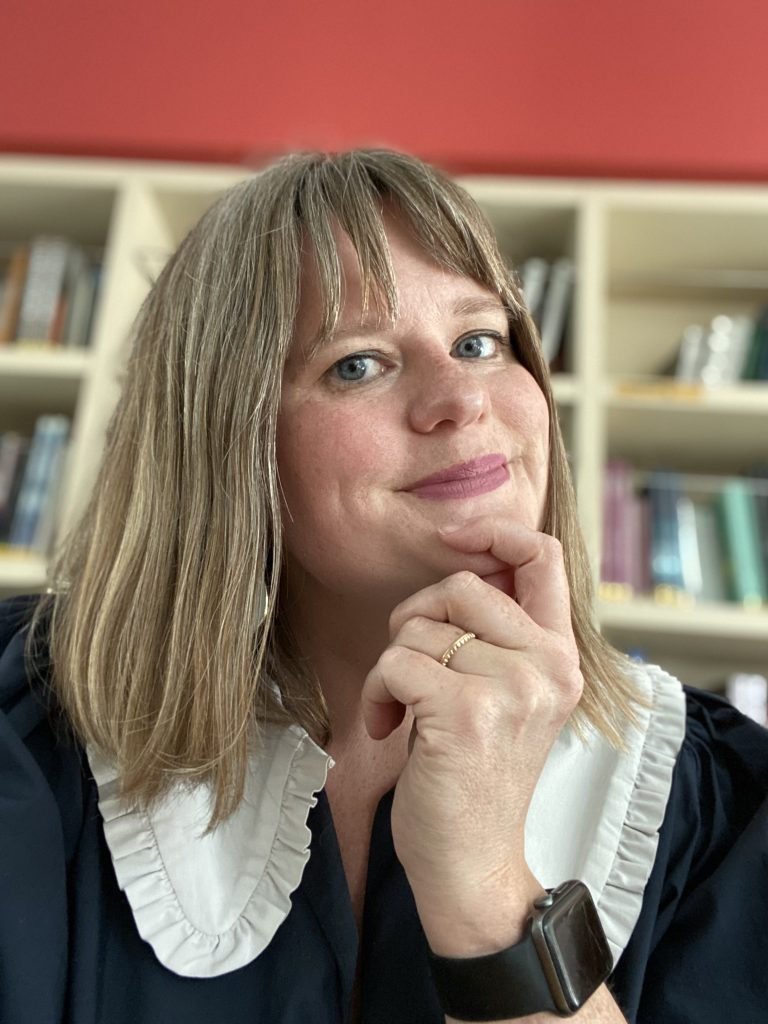
Ruth Evans Lane is a senior editor at Getty Publications, where she’s worked for over fifteen years. She develops and edits print and digital books about a variety of art topics, from scholarly tomes on bronze conservation to graphic biographies of artists for young adults.
Association of American Publishers: How do you view your role as an editor, and how do you view the relationship that you have with your authors?
Ruth Lane: I would say that my role as an editor is to make the best book possible under myriad restraints. The sky is never the limit, so we are always trying to figure out how we can do things within certain parameters.
Getty Publications is structured differently than traditional publishers in that I serve as both the acquiring editor for projects like Liberated [2024 PROSE Award winner in the category of Nonfiction Graphic Novels] but also the project manager and project editor for the book. So, I am with the book from the beginning. But even though this project came out of an idea I had—to make a graphic biography of Claude Cahun—it is Kaz Rowe’s [the book’s author and illustrator] book; their name is on the cover. They turned that glimmer of an idea into a book. So, I think my role as an editor is to facilitate the author’s work while also making sure you get the best book out of the process.
AAP: How is the process for editing a graphic novel different than for the traditional scholarly or art exhibition books that you are working on?
Lane: It’s different in so many ways, but then, all the projects that I work on are really different from each other, even if they are two exhibition catalogs. I work on scholarly books, like all the editors of PROSE titles, but I am never a subject matter expert in any of the material that I’m editing. In a sense, I am always learning how to be the best editor for a project, and I’m always learning new disciplines.
AAP: In your opinion, what are the qualities that you think make a scholarly work truly impactful in its respective field?
Lane: I think for graphic novels and for works aimed at young audiences, you have to be able to distill the concept. For books that are going to cross over and reach different types of audiences, they generally need a narrative hook. For Liberated, we have an incredible artist like Claude Cahun, whose work dovetails so nicely with the way young people use social media to construct personas. The way people talk about social interactions, like code switching or masking, are very familiar to audiences today, and are a major part of Cahun’s work.
AAP: Do you feel this is a crossover work? Is it aimed at young people, or mostly the scholarly publishing world?
Lane: My primary audience is high schoolers who like photography or are interested in gender expression. That is where I’m looking for my first audience, but audiences ripple out from each other, and they overlap. I want people who know a lot about Cahun to be interested in this book, and we worked closely with Tirza Latimer, one of the major scholars of Cahun, to make sure that everything was accurate. I do think it’s of interest to scholars, and if you’re thinking about it as a scholarly book, yes, it’s art history, but it’s also Jewish history. It’s Queer history. It’s World War II history. There are a lot of intersecting fields.
AAP: In what ways do the PROSE Awards help foster innovation and bring recognition to works in scholarly fields?
Lane: When you look at the PROSE Awards winners, they intersect broadly with numerous fields and tend to be books that are engaging to read for both readers and scholars. It’s exciting to have a book chosen for a PROSE Award because I feel like it tells you that the book is not only making a true scholarly contribution, but it’s doing it in a way that is accessible and innovative.
Entries for the 2025 PROSE Awards are currently being accepted here until midnight on November 18, 2024. For more information on the 2025 PROSE Awards, please visit our website or email proseawards@publishers.org.